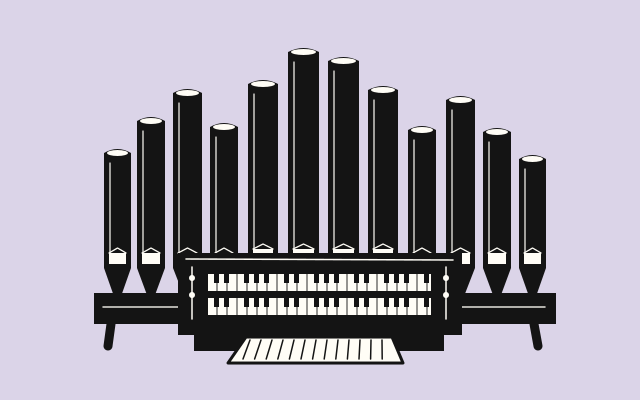
The key selects a source of sound
A pipe organ distributes pressurised air through a wind system. Keys and stops determine which pipes receive wind. A rank contains pipes for a particular tonal role, and selecting several ranks can make several pipes sound from one key. The keyboard is thus controlling a collection of acoustic sound sources.
In a flue pipe, air passes through a narrow opening to form a jet that interacts with an edge and the resonating air column. In a reed pipe, a vibrating reed regulates the flow and interacts with a resonator. These are different excitation mechanisms inside the same instrument family. Calling every organ pipe an oversized recorder would miss that distinction.
Open and stopped pipes use space differently
Compare an ideal open pipe with a pipe of the same effective length closed at one end. Their lowest resonance frequencies differ by a factor of two: the stopped pipe is lower. Their simple resonance sequences also differ. Actual organ pipes include end corrections, voicing and geometry that alter the details.
Musically, a stop choice changes both what sounds and how it blends with other ranks. The attack and the room’s lingering sound also matter. An organ heard in a reverberant space is the combined result of pipes, their placement and the room. A steady electronic chord can illustrate pitch relationships while leaving out those crucial temporal and spatial characteristics.
Test one boundary condition at a time
Use the resonance lab to compare open and closed air columns of equal length, with the same assumed speed of sound. Read the lowest-frequency prediction and the displayed mode frequencies. Then adjust the stopped tube to half the length of the open one and compare their lowest frequencies again.
The ideal relationship is useful even without audio because the lengths, frequencies and boundary conditions are stated explicitly. It is not a design specification for an organ pipe. The lab omits the mouth, jet or reed, pipe scale, wind supply and acoustic loading. Its sound is synthesized from the model’s result, not recorded in an organ or a concert hall.
An organ combines many controlled resonators, and an open or stopped boundary changes what a given pipe length can support.
Make the connection
A length becomes a note
Compare open and stopped tubes at equal length, then halve the stopped tube’s length.
Open the experiment ↗Sources & further reading
These sources support the explanations and model assumptions. Recording credits are listed in the listening panels and the source register.
- The Structure of the Pipe organ: The organ as a wind instrument ↗Yamaha Corporation · Undated
- The Structure of the Pipe organ: Positive organ ↗Yamaha Corporation · Undated