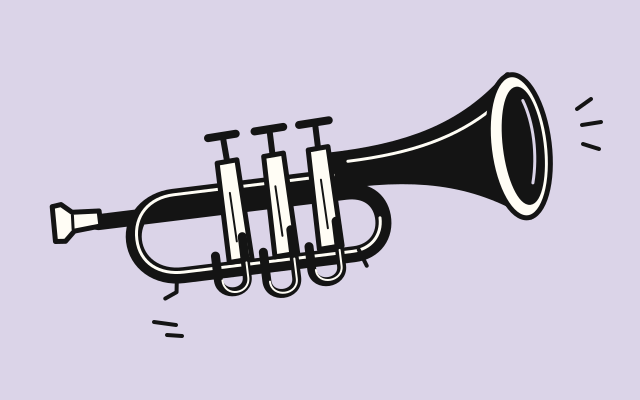
The player supplies the flexible valve
A trumpet’s vibrating lips regulate airflow into the mouthpiece. Their motion interacts with the pressure returning from the resonating air column. Breath supplies energy continuously; the lip-and-bore system organizes part of that energy into periodic motion. The mouthpiece and flaring bell affect the resonance pattern, so the instrument is not adequately described as a plain pipe stopped at one end.
The bell also influences how efficiently different frequencies radiate into the room. A spectral measurement at one microphone position is therefore a result of both the oscillation inside the instrument and the way sound leaves it. This is a reason to distinguish a model’s internal pressure from the sound a listener hears.
Evidence: 1
Valves choose a tube length, not a unique note
Pressing a valve redirects the acoustic path through extra tubing. A longer path generally lowers the resonances. However, the same valve combination can support several notes: the player changes the oscillation regime as well as choosing a tube length. Three buttons are not three oscillator switches.
Valve combinations give useful approximate pitch changes, but their tubing lengths do not automatically solve every tuning problem. Players make adjustments with slides and their control of the instrument. Musically, this helps explain why pitch is still an active listening task on a valved brass instrument. The hardware provides possibilities rather than a guarantee that every note will match a chosen tuning reference.
Evidence: 2
Keep the model’s promise narrow
Use the resonance lab to investigate how length changes a simple air column’s frequency. Predict the direction first: a longer effective length should give a lower result if wave speed and mode are unchanged. Then use the harmonic builder to distinguish a fundamental from its upper components.
The resonance lab’s cylindrical tube is not a trumpet bore. It omits mouthpiece geometry, bell flare, lip motion and changes of playing regime. The two exercises nevertheless give names to separate ideas: choosing a resonance family by changing geometry, and observing multiple components within one periodic sound. Do not mistake a high spectral harmonic for a separately fingered note played by the trumpeter.
The valves change the resonator, while the player helps choose which oscillation it sustains.
Make the connection
A length becomes a note
Change a tube’s length and predict the direction of its frequency change; note why a plain tube is only an analogy.
Open the experiment ↗Sources & further reading
These sources support the explanations and model assumptions. Recording credits are listed in the listening panels and the source register.
- Brass instrument (lip reed) acoustics: an introduction ↗Joe Wolfe, UNSW Music Acoustics · Undated
- The Structure of the Trumpet: How does the trumpet generate sound? ↗Yamaha Corporation · Undated