A continuous change in length
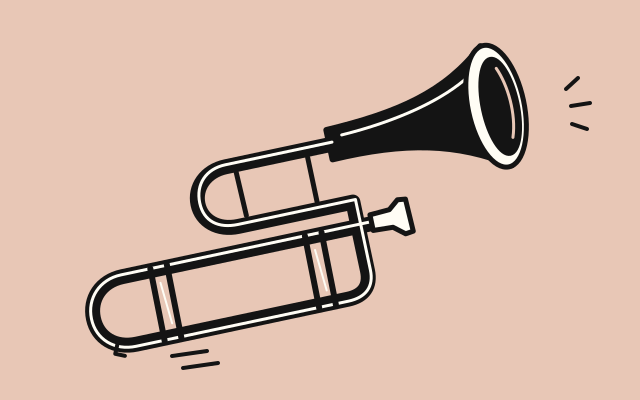
A trombone’s slide changes the length of the air path. Pulling the slide outward lengthens the path and generally lowers the resonance frequencies. The familiar numbered positions are practical reference points, not physical notches that force the instrument into a particular tuning system. Intermediate positions remain available.
As on other lip-reed instruments, the player’s lips interact with the resonating bore. One slide position supports a family of possible notes rather than a single frequency. Playing a line therefore involves coordinated changes of the slide, airflow and lip behaviour. The resonator and exciter must work together throughout the movement.
A glissando has physical limits
Consider a slide movement while the player remains in the same oscillation regime. The changing effective length can produce a continuous pitch movement. Switching to another regime introduces a different kind of change. This distinction explains why an electronic frequency sweep is easier to make arbitrarily long and smooth than every imaginable trombone glissando.
The instrument also illustrates why tuning by ear remains necessary even when positions have names. A position is an approximate physical setting; the desired pitch may depend on reference, register and musical context. This is not a claim that one tuning tradition is universally superior. It is a reminder that a continuous control can respond to more than a twelve-note numerical grid.
Evidence: 1
Read the ratio, not just the distance
In the resonance lab, compare a tube with its length increased by a fixed fraction. A ten-percent increase in an ideal tube’s effective length produces a frequency divided by 1.1, not a frequency reduced by ten percent exactly. Notice the reciprocal relationship in the numerical readout.
This model deliberately lacks a trombone’s mouthpiece and bell. Its frequencies should not be used as a fingering or slide-position chart. The useful transfer is the relationship between acoustic length and the time a wave takes to travel. For a musical follow-up, use the beating lab to compare two close pitches and hear why small tuning adjustments can have an audible consequence.
An idealised length ratio
If frequency is proportional to 1/L, then f₂/f₁ = L₁/L₂. For L₂ = 1.1L₁, the new frequency is approximately 0.9091f₁. Real trombone resonances include mouthpiece and bell effects.
The slide continuously changes acoustic length, while the lips and bore still determine the playing regime.
Make the connection
A length becomes a note
Increase tube length by a known fraction and compare the resulting frequency ratio.
Open the experiment ↗Sources & further reading
These sources support the explanations and model assumptions. Recording credits are listed in the listening panels and the source register.
- The Structure of the Trombone: How to play the scale ↗Yamaha Corporation · Undated
- Brass instrument (lip reed) acoustics: an introduction ↗Joe Wolfe, UNSW Music Acoustics · Undated