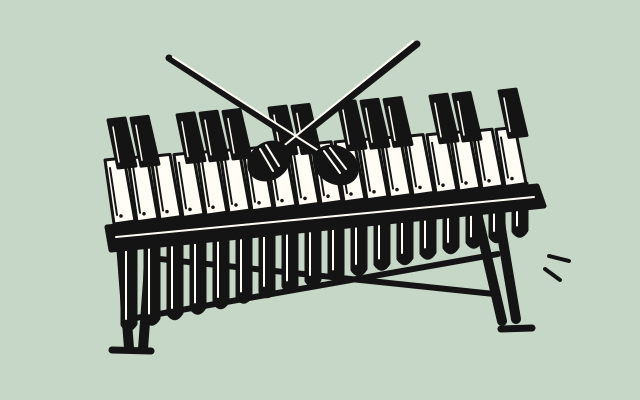
A bar bends instead of stretching like a string
Striking a marimba bar launches bending vibrations. A uniform free bar has overtones that are not exact integer multiples of its lowest bending frequency. Makers shape the underside of a bar to adjust its modal frequencies; they can bring selected modes closer to useful ratios while tuning the main pitch. The result is engineered vibration, not a wooden imitation of a stretched string.
A resonating tube under the bar reinforces radiation around an intended frequency region. The bar remains the struck vibrating source. The tube does not turn every upper mode of the bar into a harmonic, and its presence should not be confused with the excitation mechanism.
Evidence: 1
A soft or hard contact changes the balance
A brief, hard impact can excite more high-frequency motion than a longer, softer contact. The location of a strike also matters because different bending patterns move by different amounts at a given point. This gives a player ways to change the audible attack and colour while staying on the same bar.
Compare a sound dominated by one low component against a sound with stronger upper components and the same principal frequency. The second may have more percussive edge even though both suggest the same note. This is a better starting question than asking whether wood has one universal warm timbre. The shape of the bar, the contact and the resonator all need to be specified.
Evidence: 1
Identify which part the lab represents
Use the harmonic builder to make a fundamental-dominated sound, then add a stronger fourth harmonic while retaining the same fundamental. This is a deliberately simplified example of changing an upper component while preserving the main pitch. Inspect the frequency ratio and listen to the change in colour.
Do not read the result as a measured marimba spectrum. Real bars have additional inharmonic modes, and their components decay at different rates. The lab’s integer harmonic controls cannot represent every bar mode. If you switch to the envelope lab, a shorter or longer decay represents another isolated property, not a full model of wood damping or the air resonator. The two exercises together show why pitch, colour and duration deserve separate descriptions.
Marimba makers tune bending modes through bar shape; the tube below helps selected vibration become audible.
Make the connection
Build a sound
Compare a fundamental-dominated mixture with one that adds a strong fourth harmonic.
Open the experiment ↗Sources & further reading
These sources support the explanations and model assumptions. Recording credits are listed in the listening panels and the source register.
- 3.3 Marimbas and xylophones ↗Jim Woodhouse, Euphonics · Undated