Register & voicing
Move the chord, change the space
Keep a triad’s identity while spreading its notes or moving the whole chord into a new register.
Enable JavaScript for interactive controls and synthesized sound. Default model: major triad · close voicing. Notes: 130.8 Hz, 164.8 Hz, 196.0 Hz. Equal temperament, A4 = 440 Hz. Register changes spacing in hertz; preference depends on context. Original teaching tone. The original three-component tone on every chord note. Spacing, register and note frequencies remain the musical variables. Frequencies and note timing follow the controls; only the source recipe changes. Normalization uses the same bounded nominal RMS policy, not a perceptual loudness match.
Default model values
| Component | Frequency | Peak amplitude | Phase |
|---|---|---|---|
| 1 | 130.81 Hz | 0.1277 | 0° |
| 2 | 261.63 Hz | 0.0255 | 0° |
| 3 | 392.44 Hz | 0.0102 | 0° |
| 4 | 164.81 Hz | 0.1277 | 0° |
| 5 | 329.63 Hz | 0.0255 | 0° |
| 6 | 494.44 Hz | 0.0102 | 0° |
| 7 | 196.00 Hz | 0.1277 | 0° |
| 8 | 392.00 Hz | 0.0255 | 0° |
| 9 | 587.99 Hz | 0.0102 | 0° |
Listen with a purpose
Try this.
Compare low close position with low open position. The middle chord member moves up an octave. Then raise the entire chord and hear how the spacing in hertz expands.
What is happening?
In equal temperament a semitone multiplies frequency by 2^(1/12). A major triad here uses offsets 0, 4 and 7; a minor triad uses 0, 3 and 7. Open position moves the third above the fifth. First inversion places the third at the bottom. Each note uses the same selected harmonic recipe. Instrument-inspired spectra change colour while keeping the chosen note frequencies, envelope and duration.
The model & its limits
A controlled three-note synthesis in a Western triadic framework, with A4 = 440 Hz. There is no universal best register or voicing. The low-register result depends on timbre, playback system and musical context. MIDI numbers are labels, not measured loudness or pitch perception. The piano- and guitar-like spectra do not add hammer or pick transients; all choices retain the same sustained teaching envelope.
The interactive model synthesizes sound locally. Audio begins only after you press a listening button. Stop ends every scheduled voice; leaving or hiding the page stops audio. The numerical table remains useful without listening.
Static waveforms and component spectra are calculated from the current model. During playback, the waveform (except calculated swell, envelope and sampling illustrations) and spectrum come from the same browser audio signal. FFT bins have finite resolution; bars in the static view represent exact model components. A/B uses the same master volume; perceptual loudness is not calibrated.
How real instruments use this
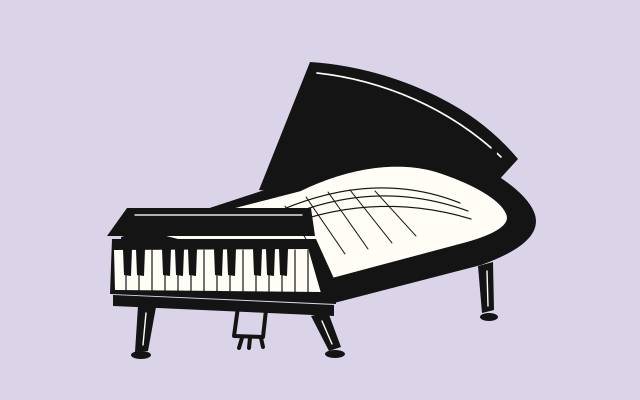
Piano
Relate chord register and spacing to ringing strings. The lab separates note placement from piano-specific coupling, pedal resonance and changing decay.

Harp
Consider how ringing strings overlap in an arrangement. Chord spacing is one part of that texture; the lab does not model each string’s separate tail.
Sources & further reading
These sources support the explanations and model assumptions. Recording credits are listed in the listening panels and the source register.
- Web Audio API 1.1 — Editor’s Draft ↗W3C Web Audio Working Group · 2026-11-06 (work in progress)
- Web Audio API best practices ↗MDN contributors / Mozilla · Undated
- Triads ↗Chelsey Hamm and Bryn Hughes / Open Music Theory · 2023 edition
- Inversion and figured bass ↗Open Music Theory contributors / Open Music Theory · 2023 edition
- What is a sound spectrum? ↗Joe Wolfe / UNSW Music Acoustics · Undated
- Scores versus timbre ↗Chris Donahue / Carnegie Mellon University · 2026
- Note names, MIDI numbers and frequencies ↗Joe Wolfe / UNSW Music Acoustics · Undated
- Interference beats and Tartini tones ↗Joe Wolfe / UNSW Physclips · Undated
- Minor scales, scale degrees, and key signatures ↗Chelsey Hamm and Bryn Hughes / Open Music Theory · 2023 edition
- Indifference to dissonance in native Amazonians reveals cultural variation in music perception ↗Josh H. McDermott, Alan F. Schultz, Eduardo A. Undurraga and Ricardo A. Godoy / Nature · 2016-07-28
- Intervals ↗Chelsey Hamm and Bryn Hughes / Open Music Theory · 2023 edition