The hammer must leave again
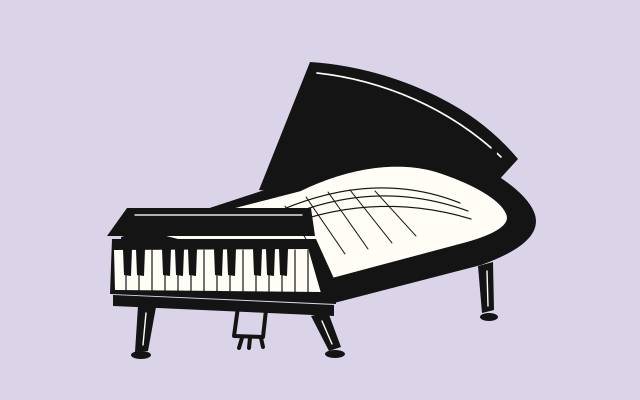
Pressing a piano key operates an action that sends a hammer toward one or more strings. The hammer transfers energy in a brief contact and then leaves the strings free to vibrate. Bridges couple that motion into the soundboard, which moves a much larger area of air than the strings could by themselves. Holding the key does not repeatedly strike the note.
Many notes have several strings tuned close to the same pitch; the bass uses fewer, heavier strings. Their coupling contributes to the evolving decay. Dampers stop many of the strings when their keys are released, while the sustain pedal changes which strings can remain free to resonate.
A fading tone can still change colour
Compare the beginning of a piano note with its later tail. The overall level falls, but the relative levels of components also change. A hammer strike, unlike continuous bowing, cannot keep replacing the energy indefinitely. The performer shapes a line through the strengths and timings of new attacks and the management of overlap.
Real piano strings resist bending. Their upper partials can lie above the exact integer multiples predicted for an ideally flexible string. This inharmonicity is one reason a perfectly harmonic oscillator stack is not a complete piano model. A tuner’s practical octave choices cannot be explained solely by typing a twelve-tone equal-temperament formula into a calculator.
Compare overlap before adding complexity
In the envelope lab, make a short and a long decay at one pitch, with a quick attack in both. Imagine placing the same succession of notes over these two tails: the longer event has more opportunity to overlap its neighbours. In the voicing lab, compare a compact chord in a low and a higher register to investigate another contributor to clarity.
These controls isolate duration and register. They do not model hammer felt, multiple coupled strings, sympathetic resonance or the pedal mechanism. A long release on an electronic sound may suggest a ringing piano, but it does not imply that a physical damper or soundboard has been simulated. Keep that distinction when interpreting the plots.
The piano gives energy in a short strike, then controls how its complex resonance is allowed to fade.
Make the connection
The beginning changes everything
Keep the attack short and compare two decay lengths at the same pitch and level.
Open the experiment ↗Sources & further reading
These sources support the explanations and model assumptions. Recording credits are listed in the listening panels and the source register.
- The Structure of the Piano: The Sound-Producing Mechanism ↗Yamaha Corporation · Undated
- The Structure of the Piano: Design of the Strings Enriches the Sound ↗Yamaha Corporation · Undated
- 5.4.3 Natural frequencies of a stiff string ↗Jim Woodhouse, Euphonics · Undated