Separate the source from the filter
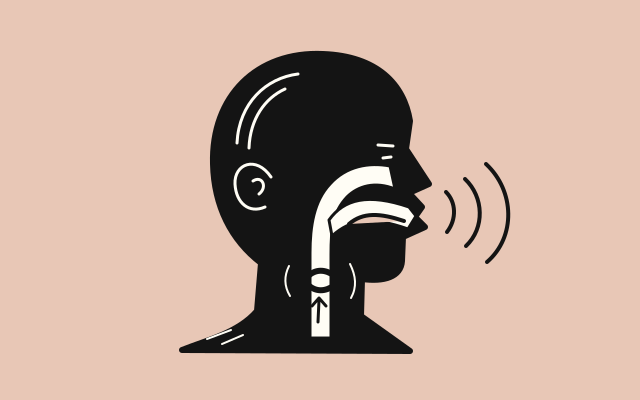
For a voiced sound, airflow from the lungs supports vibration of the vocal folds. The changing opening produces a repeating airflow pattern with a fundamental frequency and upper components. Above the folds, the throat and mouth form an acoustic system whose resonances change with the positions of the tongue, lips and other articulators.
The source–filter model separates these two processes as a useful first approximation. It helps explain how a singer can hold a pitch while changing a vowel: the repetition rate can remain broadly similar while the vocal tract reshapes the spectral balance. In real phonation, source and tract can also interact, so complete independence is an assumption rather than a universal fact.
Evidence: 1
Pitch changes and vowel changes are different
Compare holding one note through a vowel change with changing note while trying to retain a vowel. In the first task, the prominent spectral regions can move without the same change in harmonic spacing. In the second, the harmonic spacing changes with the fundamental. A spectrum can help distinguish these movements, especially when both occur together.
The word formant is used in related but not always identical ways, including prominent spectral regions associated with vocal-tract resonances. A peak in a measured spectrum does not automatically give an exact vocal-tract resonance frequency. This matters particularly at high sung pitches, where widely spaced harmonics sample the resonance response only at a few frequencies.
Evidence: 1
Explore spectral balance without imitating a person
In the harmonic builder, keep the fundamental fixed and emphasise different groups of harmonics. Listen for changes of colour while checking that the harmonic spacing is unchanged. Then change the fundamental and observe how all component frequencies move. The visual readout gives a concrete distinction between changing spacing and changing relative amplitude.
The lab is not a vocal-tract model and does not reproduce a particular vowel, language, singer or vocal technique. Its sliders directly set component amplitudes rather than calculating a changing airway. Treat the exercise as a way to understand source and spectral shaping, not as a voice diagnosis or a method for learning safe singing technique. No microphone or recording is needed.
A voice can change pitch and spectral shaping separately, although the source and vocal tract also interact.
Make the connection
Build a sound
Keep harmonic spacing fixed while changing relative amplitudes, then change the fundamental and observe the difference.
Open the experiment ↗Sources & further reading
These sources support the explanations and model assumptions. Recording credits are listed in the listening panels and the source register.
- Voice Acoustics: an introduction ↗Joe Wolfe, UNSW Music Acoustics · Undated