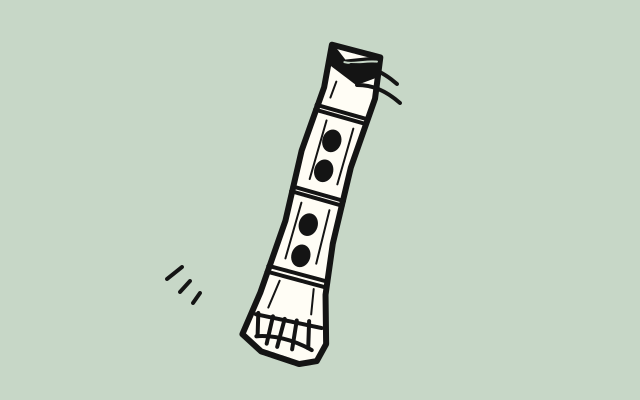
The opening and the player form one system
A shakuhachi is an end-blown Japanese flute. The player directs a jet across its blowing edge, and the jet cooperates with resonances of the bore. Unlike a recorder’s fixed windway, this arrangement leaves the geometry around the opening strongly dependent on the player. The lips and face partly obstruct the acoustic radiation from that opening.
UNSW measurements examined both the instrument alone and the radiation load shaped by a player’s face. The results support an important mechanism: changing the relationship of face and instrument can shift resonances and change their response. The wood or bamboo tube alone is therefore an incomplete description of the resonator in use.
Pitch and colour can move together
With a fingering held, changing the coverage and angle at the blowing end can alter pitch. It can also change spectral balance. The audible result is more than a note sliding up or down on a perfectly unchanged tone. This flexibility is a physical resource for performance; the acoustical explanation is not a substitute for learning a specific repertoire or tradition.
A useful comparison separates a pitch-only electronic glide from a real gesture in which pitch and tone colour evolve together. The former can establish what a frequency change sounds like. It cannot demonstrate all the expressive details of the latter. Avoid describing notes between equal-tempered keys as errors: a twelve-key grid is one framework, not a boundary on available musical pitches.
Evidence: 2
Use a model to frame a question
In the resonance lab, change the effective length of an open tube and note how its predicted frequency moves. This is an analogy for a changed acoustic boundary, not a geometrical model of a shakuhachi or its player. Next, change harmonic balance at a fixed pitch to distinguish spectral movement from pitch movement.
There are no historical or contemporary shakuhachi recordings embedded here, and the teaching tones do not claim to imitate a performer. The two experiments give you separate listening questions: did the repetition rate change, did the frequency balance change, or did both? The real instrument’s answer can depend on the gesture and context.
For a shakuhachi, the player changes the acoustic boundary as well as supplying the air jet.
Make the connection
A length becomes a note
Vary an open tube’s effective length, then distinguish that pitch change from a change of harmonic balance.
Open the experiment ↗Sources & further reading
These sources support the explanations and model assumptions. Recording credits are listed in the listening panels and the source register.
- Some shakuhachi acoustics ↗Joe Wolfe and John Smith, UNSW Music Acoustics · Conference abstract presented 2000-12-06; page undated
- Some acoustics of the shakuhachi—and of the shakuhachi player’s face ↗Joe Wolfe and John Smith, UNSW / Acoustical Society of America · 2000-12-06