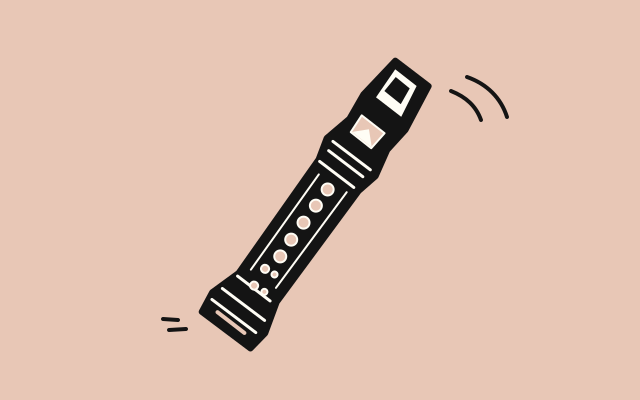
A guided jet meets an edge
The recorder’s windway forms and directs a thin air jet toward the edge at the window. This built-in channel does part of the work that a transverse flutist performs with the lips. The jet interacts with resonances of the air column, sustaining an alternating flow. A steady supply of breath can therefore produce a repeating pressure variation.
Covering or uncovering finger holes changes the resonator’s acoustic behaviour. The instrument is open at the excitation region, despite the player blowing into a mouthpiece. It should not be grouped with a stopped organ pipe merely because its head contains a block. Acoustic boundary conditions depend on where air can oscillate, not on the everyday name of a part.
A convenient mechanism still has expressive variables
Compare two attacks on the same fingering: one begins with a sudden release of air and the other grows more gently. The starting transient can change even if the sustained pitch is similar. Breath pressure can also affect pitch and spectrum, so a louder real recorder note is not necessarily a simple scaled copy of a quiet one.
This gives a useful distinction between instrumental control and laboratory control. In a real instrument, one gesture often changes several properties at once. In a lab, pitch, level and envelope can be held apart. The simplified comparison is valuable because it gives names to components of a more complicated playing action.
Compare onset without changing the note
Use the envelope lab at one fixed frequency. Make A begin quickly and B build over a longer attack. Keep their decay and harmonic mixture the same. Listen for whether the perceived start of the note follows the same place in each amplitude outline. The plot remains useful if sound is unavailable: it shows how long each example takes to approach its full level.
These electronic envelopes do not simulate the recorder’s windway, turbulence or breath-pressure threshold. In particular, they do not teach an embouchure or fingering system. Their narrower purpose is to show that articulation is a measurable time pattern as well as a musical instruction.
The recorder’s windway directs the air jet, but its notes still depend on how the resonator is driven.
Make the connection
The beginning changes everything
At the same pitch and spectrum, compare an immediate onset with a slower attack.
Open the experiment ↗Sources & further reading
These sources support the explanations and model assumptions. Recording credits are listed in the listening panels and the source register.
- The Structure of the Recorder: How is the sound of a recorder produced? ↗Yamaha Corporation · Undated
- Flute acoustics: an introduction ↗Joe Wolfe, UNSW Music Acoustics · Undated