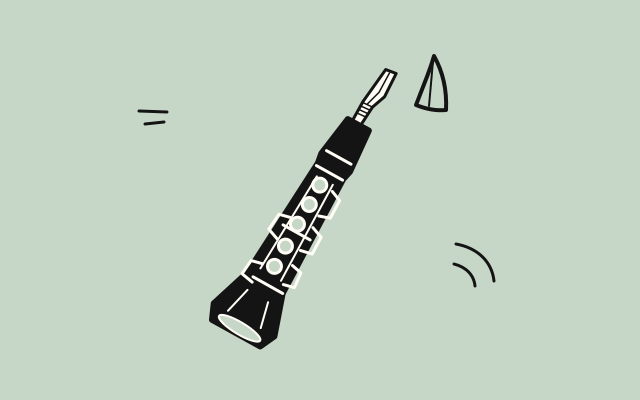
Two blades make a moving opening
An oboe’s double reed consists of two flexible blades facing each other. Breath pressure and the oscillating pressure inside the instrument bend them, changing the opening through which air can pass. The reed does not simply play its own isolated pitch while the tube amplifies it. Reed and bore influence one another and settle into a sustained oscillation when the conditions permit.
The oboe’s bore is approximately conical. Its resonances help select the playing frequency, while fingering and the player’s control alter the operating conditions. In normal playing, the blades can close for part of a cycle. This strongly shaped airflow can contribute substantial high-frequency components.
Evidence: 1
Brightness is a pattern, not a verdict
Compare a periodic tone dominated by its fundamental with one carrying more upper harmonics. The second can sound brighter at the same repetition rate. That observation helps describe one audible feature associated with many double-reed sounds. It does not imply that an oboe has one fixed spectrum, or that bright and dark are objective rankings of quality.
The real opening responds nonlinearly: increasing pressure need not produce an unlimited proportional increase in flow. The pressure range, reed stiffness and the way the player holds the reed affect whether the instrument speaks and which regime is stable. Instrument design and performance technique therefore cannot be reduced to a single volume parameter.
Evidence: 1
Isolate the spectrum from the gesture
In the harmonic builder, keep frequency and envelope fixed while increasing selected upper harmonics. Listen at the same master-volume setting and inspect which spectral bars became larger. Try describing the difference without using an instrument name: more buzzy, more concentrated, or more edge at the beginning are observations to examine rather than mandatory answers.
This experiment bypasses the reed entirely. It has no blade stiffness, changing aperture or feedback from a conical air column. The resulting tone is an original synthesized teaching sound, not an oboe sample. Its value is that it separates spectral balance from the many coupled variables in a real performance, giving you a more precise question to ask when listening to the instrument.
The double reed and bore cooperate; the strongly shaped airflow can enrich the sound’s upper components.
Make the connection
Build a sound
Keep pitch and envelope fixed while increasing upper-harmonic levels.
Open the experiment ↗Sources & further reading
These sources support the explanations and model assumptions. Recording credits are listed in the listening panels and the source register.
- Double reed acoustics: oboe, bassoon and others ↗Joe Wolfe, UNSW Music Acoustics · Undated