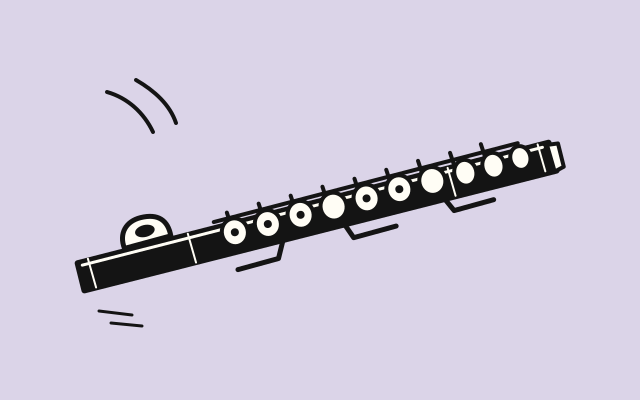
The breath supplies energy, not a ready-made note
A flutist directs a narrow air jet across the embouchure opening. The jet’s motion interacts with acoustic motion in the bore. Under suitable conditions, the resulting alternating flow supplies energy at the right phase to sustain the oscillation. The air column’s resonances and the player’s jet adjustments cooperate; a flute is not simply a whistle made by air hitting a sharp edge.
Opening tone holes changes the acoustic behaviour of the bore. A first approximation treats a flute as an open pipe, whose lowest resonance is associated with roughly half a wavelength. The actual openings, mouth geometry and end corrections make the effective length different from a ruler measurement.
Evidence: 1
The same fingering need not mean one pitch
Changing the jet can encourage a higher vibration regime without selecting a wholly different set of fingerings. The distinction is between changing the resonator’s geometry and changing how it is driven. Both can influence the sound, but they are not interchangeable actions.
For a controlled listening question, imagine two tones with the same fundamental but different strengths of upper harmonics. One can seem lighter or brighter while the pitch remains recognisably the same. Do not conclude that every flute note is nearly a sine wave: dynamics, register, player and instrument change the spectrum. The meaningful object of comparison is a specified note and gesture, not a single universal “flute spectrum.”
Evidence: 1
Use the open-pipe model carefully
In the resonance lab, select an open air column and compare two lengths. Read the predicted frequencies before playing them. Doubling the model length should halve its lowest frequency, with the speed of sound held fixed. Then change the harmonic mixture at one frequency in the harmonic builder to isolate colour from pitch.
The first experiment models an ideal tube’s resonances; the second directly synthesizes a periodic sound. Neither solves the motion of a flute’s air jet, tone holes or the player’s lips. Keep this distinction visible: a resonance is a property of how a system responds, while a spectral component is part of a sound that has actually been produced.
A flute’s pitch emerges from an air-jet and bore interaction; its spectrum is not fixed by the instrument’s name.
Make the connection
A length becomes a note
Select an open air column and double its length. Predict the frequency change before listening.
Open the experiment ↗Sources & further reading
These sources support the explanations and model assumptions. Recording credits are listed in the listening panels and the source register.
- Flute acoustics: an introduction ↗Joe Wolfe, UNSW Music Acoustics · Undated