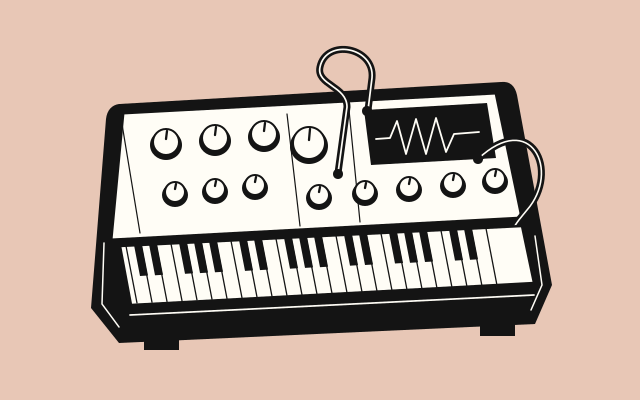
An electrical source takes the place of a vibrating body
In a classic subtractive synthesizer, an oscillator creates a repeating electrical signal. A filter changes the relative strength of frequency components, and an amplifier shapes the level over time. The word subtractive refers to beginning with a spectrally rich source and reducing or reshaping parts of it. Noise can also be a source, in which case a steady harmonic pitch is not required.
An envelope can control the amplifier, the filter or other parameters. A note can therefore begin with a bright spectrum and become darker as it fades, or do the reverse. These are design choices. The instrument does not have to obey the energy-delivery constraints of a plucked string or an air column.
Evidence: 1
One waveform does not imply one musical role
An ideal sawtooth has every integer harmonic, with amplitudes declining with harmonic number. A square wave has odd harmonics, and a triangle also has odd harmonics but a steeper decline. Their identical fundamental frequency does not make their timbre identical. Filtering and changing the envelope add further differences.
Compare a quick, short event and a slow, sustained event using the same source spectrum. They can suggest very different musical roles before any pitch changes: an articulated line versus a slowly entering layer, for example. These are listening possibilities, not fixed prescriptions. A sound’s use depends on arrangement, rhythm and context as much as its waveform label.
Build a sound and state exactly what changed
Begin in the waveform lab and compare its periodic sources at one fundamental frequency. Next, choose a mixture in the harmonic builder and alter upper components while leaving the fundamental unchanged. Finally, compare two envelopes. Keep the listening level and note duration consistent whenever those are not the intended variables.
Our implementation synthesizes digital teaching signals in the browser. It is not an analog circuit emulation and does not claim to reproduce a named commercial synthesizer. Its upper-frequency behaviour is also constrained by digital sampling. The most useful habit is to describe the actual change—harmonic balance, attack time, decay, or frequency—rather than relying only on evocative preset names. That makes the experiment repeatable and the resulting listening judgment easier to discuss.
Synthesis makes source, spectral shaping and time shape directly editable musical variables.
Make the connection
Same pitch, different shape
Compare waveforms at one frequency, then change the envelope while preserving the chosen spectrum.
Open the experiment ↗Sources & further reading
These sources support the explanations and model assumptions. Recording credits are listed in the listening panels and the source register.
- Subtractive synthesis, The Theory and Technique of Electronic Music ↗Miller Puckette, University of California San Diego · 2006-12-30
- Sound and Music: Sound Synthesis ↗Ben Lynn, Stanford University · Undated