More than a single vibrating skin
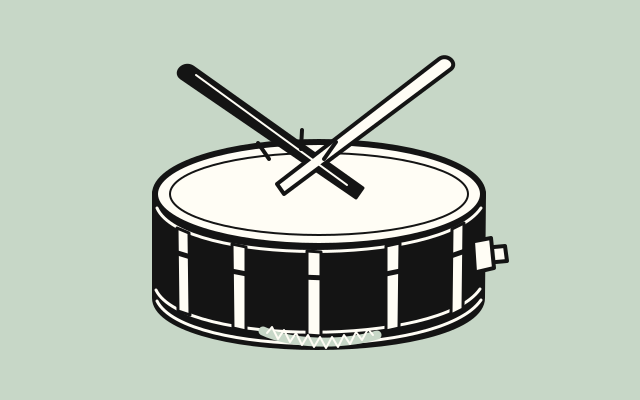
A stick strike deforms the batter head and launches vibrations across it. The air inside the shell couples motion to the opposite head. Snares touching the lower head add repeated contacts and a rattling component. The sound therefore combines several interacting systems rather than coming from a single ideal membrane.
A circular membrane has vibration modes whose frequencies are generally not exact integer multiples of the lowest mode. Changing head tension, the contact of the snares or damping can alter the result. The instrument can have a recognisable tonal range without producing the same kind of stable harmonic pitch as a flute playing a sustained note.
Compare attack, body and rattle
A useful listening description separates the initial impact, the resonating body of the event and its noisier tail. These parts overlap in time; they are not necessarily three neatly isolated sounds. Turning off or changing the snares changes the interaction, not just the overall volume.
In a rhythm, a long tail can overlap the following hit. A shorter event can leave more audible space between strokes. Neither is inherently more precise or musical: tempo, room and the intended texture matter. An accented beat also need not mean a different pitch. It may instead involve a stronger attack, a change of timbre or a longer audible event.
Investigate timing without claiming a drum model
In the rhythm lab, retain a steady pulse and place events on and between its beats. Compare a sparse pattern with a busier one at the same tempo. Focus on the relationship between onset times rather than the realism of the synthesized clicks. Then use the envelope lab to examine what a longer tail would add to each event.
Neither lab calculates the collisions of snares with a drumhead. A noise burst plus a tone can suggest a percussive sound, but that resemblance alone is not evidence of physical modelling. Here the explicit teaching question is how the timing and duration of events interact. The visible grid provides the same rhythmic information when listening is not possible.
A snare drum combines coupled membrane motion with repeated snare contacts; its timing and tail are separate musical variables.
Make the connection
Keep the pulse. Move the rhythm.
Keep tempo fixed and move events relative to the pulse. Consider how a longer decay would change their overlap.
Open the experiment ↗Sources & further reading
These sources support the explanations and model assumptions. Recording credits are listed in the listening panels and the source register.
- The Structure of the Drum: How sound is produced ↗Yamaha Corporation · Undated
- Using alternative materials for the snare ↗Yamaha Corporation · Undated
- Vibrational Modes of a Circular Membrane ↗Daniel A. Russell, Pennsylvania State University · Original 1998-01-21; HTML update 2025-08-15