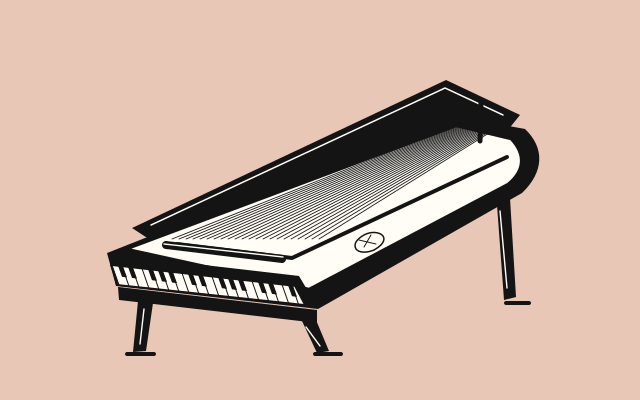
A pluck hidden behind a key
On a harpsichord, a key lifts a jack carrying a small plectrum. The plectrum deflects and releases a string. On the return journey, the mechanism allows the plectrum to pass without making the same pluck again, and a damper can stop the vibration. This is a mechanically controlled pluck, not a smaller version of the piano’s hammer strike.
The vibrating strings transmit energy through bridges into a soundboard. Depending on the instrument, different sets of strings can be selected, and some instruments have more than one keyboard. The keyboard is an interface; it does not by itself tell you whether the sound source is a string, an air column or an electronic circuit.
Expression without piano-style velocity control
The standard harpsichord mechanism offers little of the piano’s direct control of single-note loudness through key velocity. That does not make the instrument expressionless. Note length, the spacing of attacks, the number of notes sounding and the selection of registers give a player other ways to shape a phrase.
Compare two imaginary three-note phrases with identical pitches and nominal levels. In one, each note ends before the next; in the other, their tails overlap. The first can sound more separated and the second more connected without a change in the pitch collection. This is an original listening thought experiment, not a claim about a particular historical performance style.
Evidence: 2
Listen to articulation as a variable
Use a short attack in the envelope lab and compare a brief tail with a longer tail. Keep the harmonic mixture unchanged. After hearing each, ask whether the difference concerns the onset, the duration or the tone colour. This habit helps avoid attributing every audible distinction to a different instrument.
A real harpsichord’s plucking point, string materials and resonating structure also matter. Its upper components need not match the lab’s preset amplitudes, and a single electronic decay is a deliberate simplification. The experiment represents the idea of a plucked event and its duration; it is not a sampled instrument or a historical reconstruction of one.
The harpsichord’s plucking action makes articulation and overlap especially useful variables to notice.
Make the connection
The beginning changes everything
Retain a quick attack while comparing short and long tails. Listen for separation versus connection.
Open the experiment ↗Sources & further reading
These sources support the explanations and model assumptions. Recording credits are listed in the listening panels and the source register.
- The Harpsichord ↗Bate Collection, University of Oxford · Undated
- Renaissance Keyboards ↗Rebecca Arkenberg, The Metropolitan Museum of Art · 2002-10-01
- Strings, standing waves and harmonics ↗Joe Wolfe, UNSW Music Acoustics · Undated